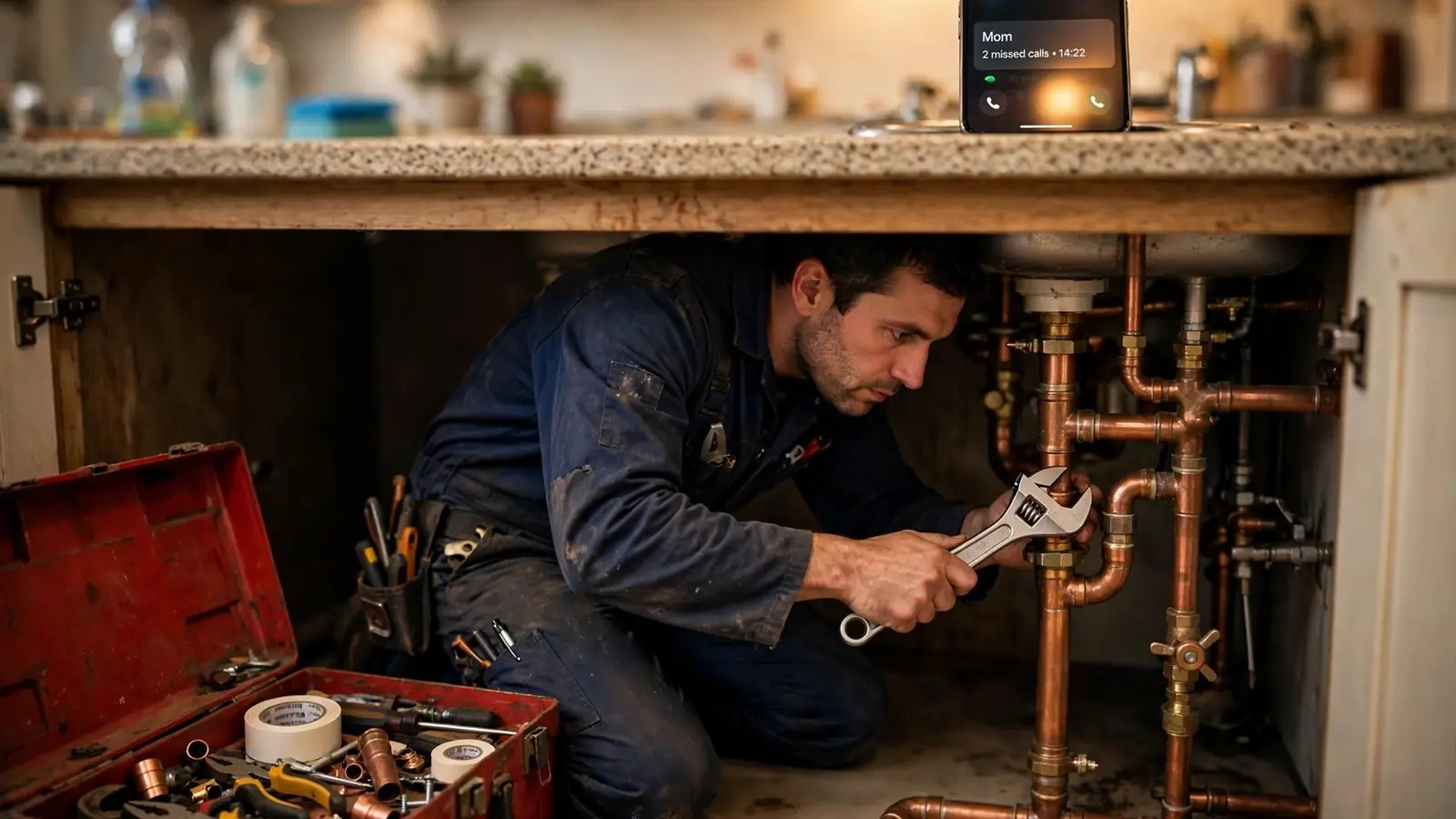
Picture Tuesday. You are under a kitchen sink, both hands on a wrench, water on your sleeve. Your phone rings on the counter. Then it rings again. By the time you are free, there are two missed calls and no voicemail. You tell yourself you will call back after this job. You forget. They have already booked someone else.
This is not a story about being disorganised. This is the normal working day of every plumber, HVAC tech, and electrician doing the actual work. The phone rings hardest when your hands are fullest. And every one of those calls was a customer with a problem and a wallet, choosing between you and whoever picks up first.
Do the maths on your missed calls
Let us use honest numbers, not scare tactics. A busy trade business misses around 15 calls a month. Not because anyone is lazy: because you are on roofs, in crawl spaces, and under sinks, which is where the money is made.
Now the part that hurts. Industry research keeps landing in the same place: roughly 6 in 10 calls to small businesses go unanswered, and the large majority of those callers never call back. They do not leave a voicemail. They do not try again tomorrow. They scroll to the next number.
So take your 15 missed calls. Say half of them would have become paying jobs. That is 7 or 8 jobs a month. At a $550 average job, that is around $4,100 a month walking past your business. Over a year, that is just under $50,000. Not a rounding error. A second van. A full-time hire. Your kid's college fund, ringing unanswered on a kitchen counter.
$50,000
What 15 missed calls a month can cost in a year
Run it with your own numbers. Count last month's missed calls on your phone right now. Multiply by your average job value. Then halve it, to be conservative. Whatever number you land on, that is what your current system for missed calls is worth: nothing, because you do not have one.
Why "I'll call them back later" loses the job
The call-back plan fails for a reason nobody talks about: speed is the product. When someone's boiler dies in January or a pipe bursts at midnight, they are not shopping. They are panicking. Research on buyer behaviour says nearly 8 in 10 customers go with whoever responds first. Not the cheapest. Not the best reviewed. The first.
"Later" in trade time means three jobs from now, which means tomorrow, which means never. And here is the part that stings: the customer does not think "he must be busy on a job." They think "he must not want the work." Silence reads as indifference. Every hour of it sends them further down the list.
You already know this from the other side. When you needed an emergency electrician last year, how many numbers did you call before someone picked up? Two? Three? You did not wait for a call back. Neither do your customers.
The 11pm test
Here is the scenario that decides everything. It is 11pm on a Tuesday. A pipe bursts in a customer's kitchen. Water is spreading across the floor. They call three plumbing companies. Company one goes to voicemail. Company two goes to voicemail. Company three texts back within a minute: "Sorry we missed you, what is going on? We can have someone there tonight."
Who gets the job? It is not a contest. The customer is standing in water. They reply to the text, the job gets booked, and company three just won a $700 emergency call-out while its owner was asleep.
Now ask the only question that matters: which company are you right now? If your answer depends on whether you happen to hear the phone, you do not have a system. You have luck. Luck is not a business strategy.
The 60-second text-back: what actually changes
The fix is almost insultingly simple. Every missed call gets a text back within 60 seconds: "Sorry we missed you, what is going on?" That is it. No new hire. No office manager. No changing how you work.
Here is why it works. A text back does three things a voicemail never does. First, it arrives while the customer is still holding the phone, still in decision mode. Second, it turns a dead end into a conversation: they reply with the problem, and now you have a lead instead of a missed call. Third, it signals that you are responsive, which is the entire buying decision in an emergency.
The customer replies. The conversation is sitting in your messages in the morning. You book the job between calls, instead of discovering three days later that you never called back. Same phones. Same staff. Same you, under the same sink. The only change: no missed call goes quiet anymore.
And it works at 11pm, on Sundays, during the school run, and through every hour you are not available. Which, if you are honest, is most hours.
The reviews you never ask for
Quick question: when did a happy customer last leave you a review without being asked? If you are like most trade businesses, the answer is never. The only people who review unprompted are the furious ones. So your public reputation is written by your worst day, not your best work.
This is backwards, and it is fixable with the same thinking as the text-back. After every finished job, the customer gets a simple message: "How did we do?" The happy ones tap five stars and land on Google. The unhappy ones reply to you privately instead of publicly, which gives you the chance to fix it before it becomes a one-star review for the whole street to read.
Ten extra five-star reviews will do more for your quote pipeline than any advert you have ever run. Customers choose the plumber with 120 reviews over the one with 12, every time. You did the work to earn those reviews. You just never asked.
See how trade businesses never miss a call again
The 60-second text-back is the first piece. The full system also chases every quote, follows up every estimate, and asks every happy customer for a review. See how it fits together for service businesses.
You don't need more staff. You need the phone answered.
Every solution you have been offered for this problem was really a staffing problem in disguise. Hire an office manager: $45,000 a year plus training, plus sick days, plus the fact that she also cannot answer at 11pm. Get a call answering service: per-minute charges and a stranger reading a script who cannot book a job properly. Do it yourself: you have tried, and the sink always wins.
There is now a fourth option, and it is the first one built for how trade businesses actually work. SIBT builds what we call a specialist SI bot team for service businesses. Forget the name. In plain English: it is office staff made of software. It texts back every missed call in under a minute, chases every quote you send, follows up every estimate, and asks every happy customer for a review. It works at 11pm on a Tuesday. It never forgets, never sleeps, and never calls in sick.
You keep doing the work you are good at. The phone, the quotes, and the follow-up take care of themselves. See exactly what it does for a business like yours, then ask yourself what last year's missed calls were worth. You already did the maths.